

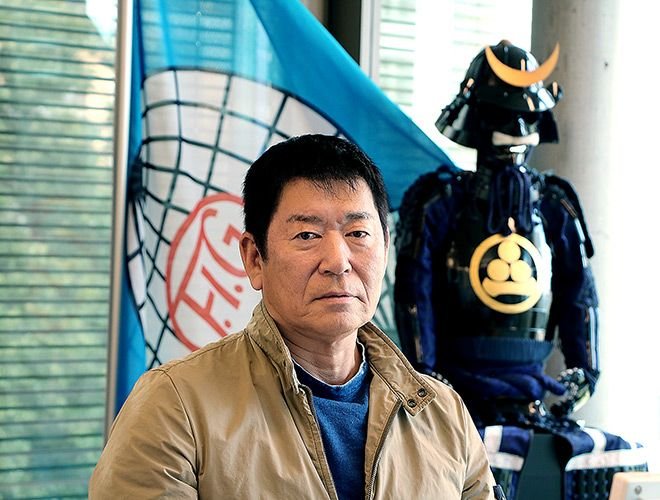
Morinari Watanabe, the Japanese head of the International Gymnastics Federation (FIG), is vying to be selected as the first president of the International Olympic Committee from Asia in the election in Greece in March.
All nine presidents of the more than 130-year-old body have been either from Europe or from the United States.
“It is high time for the traditionally Eurocentric IOC to change itself into a body that is global in the true sense of the word,” Watanabe said when asked about his chances of becoming the first IOC president from Asia. “I think things should turn out that way.”
Watanabe, 65, explained that he is running to lead the global Olympic movement because he always has sought the top spot in his career.
“I started out as a salaried employee,” he said. “I have been doing my best to fulfill the tasks my bosses have assigned to me. As an extension of doing so, I have also aimed for the top post whenever I wish to achieve something. That has been my goal throughout my life.”
When asked what he hopes to achieve if elected IOC president, he said: “Sports have social values, such as international exchange and longevity in good health. I want to create a better environment for sports lovers, athletes and children from around the world.”
As a student at Tokai University, Watanabe went to study in Bulgaria, where he encountered rhythmic gymnastics.
During his job-hunting activities, he pitched proposals for operating rhythmic gymnastics courses, and he joined supermarket chain operator Jusco Co., predecessor of today’s Aeon Co., where he has worked hard to spread rhythmic gymnastics.
Watanabe was elected FIG president in 2016 after serving as managing director of the Japan Gymnastics Association and in other stints. He is currently the only one Japanese to lead an international federation of an Olympic sport.
Watanabe became an IOC member in 2018.
He said he set a condition when IOC President Thomas Bach of Germany approached him with a proposal recommending him for IOC membership.
“I will accept your offer if only you were to assign me tasks,” he said he told Bach. “But I wouldn’t be interested in just the honor.”
Watanabe remained busy in the runup to, and during, the Tokyo Summer Olympics of 2021, where he was, for example, assigned to supervise boxing, which faced a mountain of problems including dishonest judging, in addition to his original “turf” of gymnastics.

Watanabe was deemed, within the IOC, as a loyal and trusted follower of Bach.
However, he rebelled against the president during the IOC session of October 2023, when some of his fellow members called for extending Bach’s term, which was expiring in 2025.
Watanabe was the only member to argue that Bach should observe the Olympic Charter provision, saying the president’s term should not exceed 12 years.
“In the past, failures in organizational governance led to corruption and tarnished the image of sports,” Watanabe told the session. “The IOC should be a model for international sport federations.”
Bach has grown increasingly dictatorial in recent years, and proceedings at meetings of the IOC session, which is supposed to be the supreme decision-making body, have become weaker as a result.
No one expressed agreement with Watanabe during the session, but he quoted fellow IOC members as telling him later: “You are right, Morinari.”
“I have been backing Bach,” Watanabe said. “That’s precisely why I didn’t want the leader of the body, who should be observing the rules, to disgrace his twilight years.”
Bach said last summer that he was stepping down when his term expired.
INNOVATIVE PROPOSALS
Seven filed candidacies as Bach’s successor. Watanabe included in his manifesto an ambitious proposal for having Olympic Games cohosted, in the future, by five cities from the five continents.
“Only economic powers can afford to host the Olympic Games that have grown so huge as they are now,” he said. “Perhaps we have to think outside the box so the excitement will be shared on all five continents at the same time.”
Watanabe is also proposing having the Games include a total of 50 sports, 10 of them per host city. He said the use of digital technology will allow a sense of togetherness to be fostered across the globe.
He said that increasing the number of Olympic sports from 32 in the 2024 Paris Games would come with the advantages of opening the door to emerging sports and allowing smaller cities to host the Games.

His proposal would make it impossible for athletes from around the world to assemble at a single venue.
Watanabe said, however, that, even as things stand now, “many of the athletes are so focused on their competitions during the Olympic Games that they have few opportunities for mutual interactions.”
He is presenting an alternative plan for organizing an “Olympian Forum” for bringing athletes together and having them share Olympic values there.
Watanabe has been practicing international exchanges through sports on his own as well.
He persuaded his superiors into founding the Aeon Cup Worldwide Rhythmic Gymnastics Club Championships, which have been held in Tokyo annually since 1994, out of a desire to reconcile ethnic groups that had been divided during the Bosnia-Herzegovina conflict.
Part of the proceeds from the Aeon Cup have been donated to the Office of the U.N. High Commissioner for Refugees.
After Russia began its invasion of Ukraine in 2022, Watanabe helped invite Ukrainian athletes, who had lost training venues due to bombings, to a pre-championship training camp in Japan.
“I believe that sports have the potential to serve as a bridge for peace, whatever the discord between states is,” he said.
‘FIELD-ORIENTED’ HARD WORKER
Watanabe’s credo is to be “field-oriented.”
He hops from one country to another at a pace of approximately one trip every three days. He does so alone without being accompanied by a secretary or subordinates.
He has made the rounds of about 160 nations, since he assumed the post of FIG president, to tour the front lines and listen to the views of local people.
Watanabe sleeps only about four hours a day.
“I believe that the hours while sleeping are basically wasted,” he said. “Everyone is given 24 hours a day. I want to use them as effectively as possible.”
His lifestyle that evokes that of an eager corporate employee from the period of Japan’s high economic growth may appear old-fashioned in this age, where “work style reform” is the order of the day in Japan.
Watanabe, in the meantime, is also keeping pace with the trends of the times. He has spared no effort in updating information to stay abreast of the sensibilities of Generation Z and younger people who have been exposed to the online world since early in their lives.
He has formed the habit of observing, without trying to do so, ad signboards, TV commercials and other things he sees in cities across the world that he visits.
Watanabe has a strong opinion about the closed nature of Japan’s sporting world.
“It is traditionally a class society,” he said. “Coaches stand at the top, and there are upperclassmen and underclassmen. Many quit this world because they don’t like these up-and-down relationships, this hierarchy. They begin very young and leave still young. That’s why sports don’t take root as part of lifestyles.”
He said that, in comparison, he senses an open atmosphere, largely free from vertical relationships, in emerging Olympic sports such as skateboarding and sport climbing.
Watanabe’s respect for the bottom-up approach is also reflected in his IOC administration proposal. He is calling for the introduction of a bicameral system to change the current setup, whereby the authority tends to be concentrated in the executive board.
He has proposed having matters discussed by a “House of Representatives,” which would consist of national and regional Olympic committee presidents and the heads of international federations governing Olympic sports, and have them decided by a “Senate” consisting of IOC members.
It remains to be seen if Watanabe’s proposals will win the approval of the electorate of the 110 or so IOC members.
His rivals include Juan Antonio Samaranch Jr. of Spain, whose father reigned as IOC president for 21 years, and Sebastian Coe of Britain, a former Olympic gold medalist middle-distance runner, who is the president of World Athletics.
Watanabe and his rival candidates gave presentations before an audience of IOC members in Lausanne, Switzerland, on Jan. 30.
***
Morinari Watanabe was born in Kita-Kyushu, Fukuoka Prefecture, in 1959. He joined Jusco Co. in 1984. He has been the International Gymnastics Federation president since 2017.
Original Source: This article was originally published on Asahi Sports. Click the link to view the full article.