

Riku Miura and Ryuichi Kihara electrified the crowd in capturing Japan’s first-ever Olympic gold medal in pairs figure skating on Feb. 16, staging a dramatic comeback at the 2026 Milano Cortina Winter Games.
The pair, affectionately known as “Rikuryu,” delivered a flawless, world record-setting free skate program to vault from fifth place after a rare error in the short program and claim the historic title.
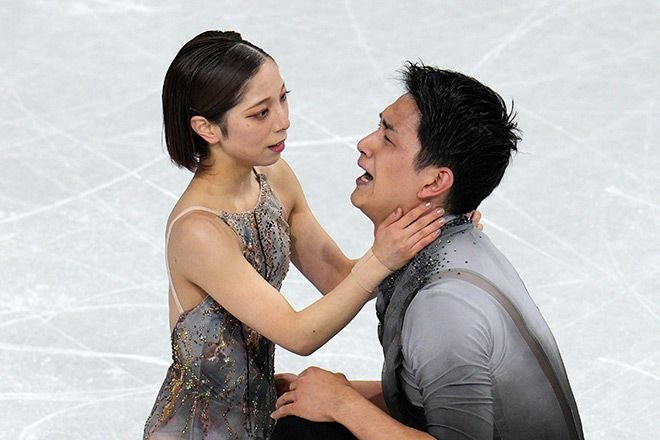
When their performance ended, the two collapsed to their knees on the ice and embraced.
As Kihara, 33, shed tears, seemingly released from the weight of expectations, Miura, 24, gently supported and comforted him.
Their performance under supreme pressure was the culmination of an unlikely journey.
This landmark achievement, however, might never have happened without a chance encounter seven years earlier.
ON THE BRINK OF QUITTING
A recent exchange in Nagoya offered a window into their unlikely beginnings. While practicing for a competition this winter, Kihara pointed to the lodging facility beside the rink where he once had a part-time job.
“I used to work at the front desk here,” he said.
Miura replied, “I’ve heard that story so many times.”
That story begins seven years ago, when Kihara was on the verge of quitting the sport entirely.
A two-time Olympian at the 2014 Sochi and 2018 PyeongChang Games, Kihara was suffering from a shoulder injury and concussions.
In the spring of 2019, he and Miu Suzaki dissolved their partnership. He returned to his home in Aichi Prefecture and began working part time at Howa Sports and Culture, the rink where he had trained as a child.
At 26, while friends his age were starting their careers, Kihara was convinced his was over.
“I’m not cut out for pairs,” he thought. “I’ll aim for the Japan Games in singles and then maybe retire.”
Yusuke Iioka, 34, who worked for the company that operates the rink, remembers Kihara’s awkward job interview.
“It seemed as if he felt a sense of inferiority for having only ever done skating,” Iioka said.
Kihara’s duties included handing out rental skates, monitoring the ice and working the night shift at the lodging facility.
When young children came to the rink, he would kneel down, making his 175-centimeter-tall frame smaller, to speak with them at eye level.
He wasn’t given special treatment just because he was a two-time Olympian. His hourly wage was the same as a university student’s.
But the humbling experience had an upside.
The younger skaters treated him as they always had, without ceremony.
“He was able to talk with them without any pretense,” Iioka recalled. “During that troubled time, he wasn’t alone.”
A FATEFUL ENCOUNTER
In June of that year, the Japan Skating Federation held a pairs tryout at Kihara’s alma mater, Chukyo University.
Yoshiko Kobayashi, 70, a federation director, asked Kihara, “There’s no pay, but please come and help out.”
Kihara agreed.
That day, after finishing about three hours of offering assistance, Kihara was ready to head home.
As he was leaving, Kobayashi said, “Thank you, Ryuichi-kun. Let me know when you’ve decided what you’ll do next.”
Just as Kihara reached the automatic doors to exit, someone came running after him.
It was coach Bruno Marcotte, 51.
“Ryuichi, put on your skates,” he called out. “Why don’t you try skating with Riku for just an hour?”
Marcotte, a Canadian who has long helped develop Japanese pairs, was coaching Miura and her then-partner, who were also practicing at the rink that day.
Their future partnership was uncertain, prompting Marcotte to approach Kihara.
He agreed.
On the ice, the pivotal moment came on a twist lift. When Kihara launched Miura, her body soared so unexpectedly high that Marcotte instinctively exclaimed, “Oh my God!”
The few federation officials watching were left speechless in amazement.
“This is what it feels like to be struck by lightning,” Kihara later recalled.
It was the moment his heart was pulled back to the ice.
“He rediscovered his love for skating that day,” Marcotte said.
A METEORIC RISE
A month later, Kihara and Miura, whose previous partnership had ended, skated together again.
Kihara marveled at Miura’s trust, Iioka recalled.
“For the woman, being thrown in the air is scary,” Kihara told him. “There’s always a moment where the body tenses up, which changes the weight. But Riku had none of that at all.”
In August, their new pair was formally announced. They moved to Canada to train with Marcotte and their meteoric rise to the top of their sport began.
The pair quickly became a dominant force, capturing a groundbreaking seventh place at the 2022 Beijing Olympics—a best for any Japanese pair—and followed it by winning the World Championships in 2023 and 2025.
They arrived in Milano Cortina as top contenders for the gold.
GOLDEN REDEMPTION
Despite their preparation, disaster struck in the short program on Feb. 15.
A mistake they said never occurs in practice caused a lift to falter, leaving them in a distant fifth place.
Kihara could not hide his dismay at the result. His shoulders slumped on the ice and his expression was grim in the media interview area.
Miura, however, remained calm and resolute.
“We made a mistake today, so we have to reset. If we believe we can do it, we can.”
She turned to Kihara standing to her left and said encouragingly, “Let’s refocus, OK?”
Kihara vowed to return the next day in better spirits.
“Tomorrow, I promise we will be back here (in the interview area) talking like the usual ‘Rikuryu.’ Please wait for us,” he told reporters.
Needing a flawless performance to reach the top of the podium, they delivered. On Feb. 16, they executed every element with power and precision.
Their signature speed never faltered. With each lift and jump, the packed arena erupted. They had delivered their finest performance when it mattered most.
Their score flashed on the screen: a new world record of 158.13 points in the long program. Kihara let out a roar of triumph; Miura covered her mouth in astonishment. Their total score of 231.24 was enough to come from behind and make history.
“To be able to recover from yesterday’s mistake and show the strength we’ve built up all this time, that’s what makes me the happiest,” Miura said.
Kihara, who never forgot the day that changed his life, has often said, “I’m truly grateful to the people who gave me that opportunity.”
Holding the gold medal, he expressed the ultimate reward for that second chance: “I’m so glad I didn’t give up.”
(This article was compiled from stories written by Kai Uchida and Hiroki Tohda.)
Original Source: This article was originally published on Asahi Sports. Click the link to view the full article.