

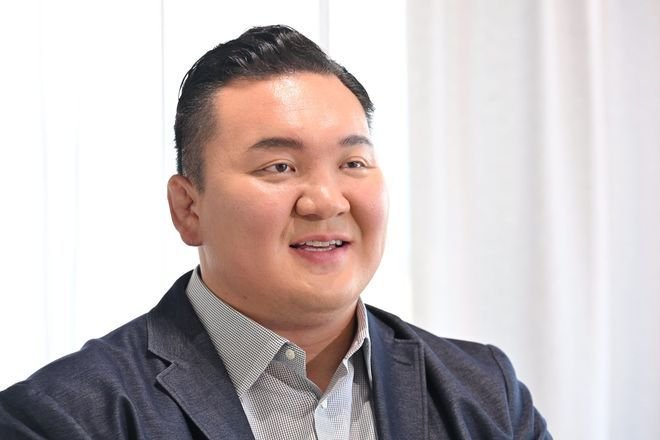
Retired yokozuna Hakuho towers over other greats in the long history of professional sumo.
His record 45 championships appears unlikely to be matched or exceeded by any wrestler in the near future.
Although Hakuho joined the Japan Sumo Association as an elder, like many accomplished wrestlers, after his retirement in 2021, he resigned from the sport’s governing body last year.
SPREADING SUMO WORLDWIDE
The 40-year-old native of Mongolia is now tackling a project to expand the global population of amateur sumo wrestlers, eyeing the launch of a new international competition.
What drives him, he said, is a sense of alarm at the shrinking pool of apprentice wrestlers.
The number of professional sumo wrestlers has been hovering just below 600 for the past few years after reaching around 950 in 1994 at the peak of the sport’s popularity. The decline in newcomers is taking its toll on the sport.
“This is an alarming situation,” Hakuho said in a recent interview in Tokyo.
Hakuho is no stranger to efforts to promote Japan’s traditional sport among young aspirants around the world. He started the Hakuho Cup in 2010, three years after he rose to yokozuna, sumo’s highest rank, at the age of 22.
The competition grew into an event that saw entries of more than 1,000 young wrestlers representing about a dozen countries.
In the latest competition held in Tokyo on Feb. 7 and 8, about 350 female wrestlers participated for the first time in its history.
But there were only a few from aboard who moved on to sign with a stable to pursue a professional career.
One of the biggest obstacles is thought to be a rule that restricts the number of international wrestlers to one per stable.
“One wrestler per each of the five continents should be accepted in stages,” Hakuho said. “There are many wrestlers also in the Middle East and Southeast Asia who are hungry for success in professional sumo. We are living in an age where the sport should go global, be fully open and take in wrestlers from overseas under a set of solid rules.”
The new project that Hakuho has been working on is “The World Sumo Grand Slam,” where entrants will compete for the title of the world’s No. 1 amateur wrestler.
He is partnering with Akio Toyoda, chairman of Toyota Motor Corp., who recently assumed the top position of the International Sumo Federation, which is tasked with spreading sumo globally. The federation has more than 80 member nations and territories.
The envisioned competition sets it apart from the existing events for amateur wrestlers in awarding prize money to the winners, an incentive to attract more competitors.
“Children, who will be the future leaders, will be given more options to compete,” Hakuho said of the potential benefit of the event. “I want to lay the foundation for it.”
He expects the first World Sumo Grand Slam to be held at Toyota Arena Tokyo in 2027 at the earliest. The goal of the World Sumo Grand Slam, he said, will be achieved if sumo is someday selected as an Olympic sport.
SUMO REFORM AN UPHILL FIGHT
With his prowess and unparalleled records, he could have remained in the Japan Sumo Association to help it sort out challenges and set out a new path for the sport’s future.
But Hakuho believes that it was an impossible task.
“There wasn’t much I could do from within to reform the sumo world,” he said. “I could not fully utilize my ideas and ability while I was there.”
He cited the politics of factions within “ichimon,” a clan consisting of sumo stables, and many other conventions steeped in tradition as impediments.
“Reforming that area will likely take a lot of time,” he said.
There are currently five ichimon, which all 45 sumo stables must belong to.
Working with dozens of fellow elders at the association was totally different from Hakuho’s experience as a wrestler.
When you are fighting in the dohyo, he said, all that matters is your ranking if your opinions are to be heard and considered.
In the association, it is seniority that gives members the power to speak up and change things.
Hakuho said he sensed the rigid mindset where junior elders, like himself, were discouraged from speaking up at meetings.
He recalled one conference where more than 100 sumo elders attended.
One of the attendees suggested that the association should listen more to what junior elders had to say.
“We are talking about the next century of sumo, but none of us will still be alive then,” Hakuho quoted the elder as saying in trying to solicit input from his junior colleagues. “Then the official of the association’s executive board shot back, ‘The matter should be left to the future executive board,’ and everyone fell silent.”
Some sought to push back.
One notable rebel was Takanohana, a popular retired yokozuna who won 22 championships. His dizzying ascent to the pinnacle of the sport along with his brother Wakanohana created the sumo boom in the 1990s, bringing an army of hopefuls to stables.
After leaving the dohyo in 2003, the reform-minded Takanohana ran in the election of the association’s 10-member board of directors in 2010 against the wishes of elders within his clan.
It was customary for a clan to select its candidates based on consensus. Elders in Takanohana’s clan regarded him as too young to run for the seat. The stable he ran was expelled from the clan as punishment for breaking with tradition.
Takanohana was elected to the board. But he subsequently clashed with the association’s executive board and grew isolated from other senior officials. Takanohana quit the association in 2018.
PRIDE OF A YOKOZUNA
While Hakuho’s accomplishments as yokozuna are undeniable, he was occasionally criticized by sumo authorities and fans for his “rough tactics.”
Yokozuna, in particular, are expected to fight with dignity in keeping with the spirit of sumo. Resorting to techniques that may be within the rules but undignified is considered unbecoming of a yokozuna.
Hakuho’s excessive use of slaps to the face and sidestepping an opponent rather than meeting them head-on, among other maneuvers, were frowned upon. He was also admonished for remarks and gestures he made in the ring when upset.
“Nobody taught me about the dignity (of being a yokozuna),” Hakuho said. “The spirit of sumo is not something that others will teach you, but you feel and learn it yourself.”
He also said that a yokozuna can maintain his dignity by continuing to win.
“No matter how young and respectable, a yokozuna must retire if he cannot win,” he said.
Wrestlers up to ozeki, the second highest rank, can remain competing in the dohyo even if they continue posting losing records over the 15-day tournaments, which are held six times a year. They just face demotion to a lower rank.
But a yokozuna is expected to retire if his records are unworthy of his status.
“I have always thought that you can become an ozeki if you are strong enough, but only those having a preordained destiny will reach the rank of yokozuna,” Hakuho said.
Hakuho said he is proud of fulfilling his responsibility as a yokozuna more than anyone who has achieved that lofty rank.
“Yokozuna and ozeki are indeed in a different league (compared with other wrestlers), and they tend to have ideas different from others,” he said.
It is unreasonable, Hakuho said, that the association tends to dismiss even accomplished wrestlers because of their low seniority within the organization.
“It is perplexing that some yokozuna who left their marks on sumo history are no longer with the association,” he said, referring to Takanohana.
Although Hakuho parted ways with the professional sumo world, he did not rule out the possibility of joining forces with the association again someday.
“I love sumo,” he said. “Good days for the sumo world will not last forever and my services may be called upon in 10 years or 15 years from now.”
Original Source: This article was originally published on Asahi Sports. Click the link to view the full article.