

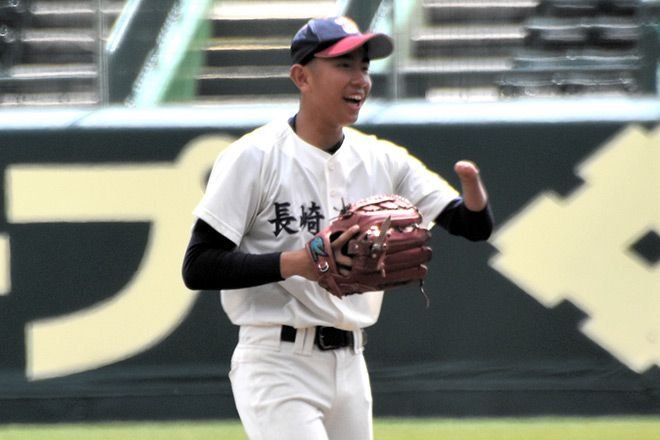
As a child, Yuki Hiraki, who was born without a left hand, was told the harsh reality by his father that the missing limb would never grow.
But throughout his childhood, Hiraki took to heart other words from his father: “You can do anything.”
Now a second-year high school student, Hiraki earned a spot on his school’s baseball team that has entered Japan’s prestigious Senbatsu spring national tournament.
The 13-day tournament, held at Hanshin Koshien Stadium in Nishinomiya, Hyogo Prefecture, features 32 of Japan’s top high school teams.
Hiraki fulfilled a lifelong dream when he and his Nagasaki Nishi High School teammates marched onto the field for the opening ceremony on March 19.
During practice a few days earlier, Hiraki, wearing jersey number 20, ran across the hallowed ground, unable to contain his joy.
“It was fun,” Hiraki said after the practice. “To be able to play in a place I’ve only seen on TV, it felt special, like I’ve really made it to Koshien.”
Hiraki catches the ball in his right-hand glove, tucks it against his left arm and chest, and in a flash, transfers the ball to his right hand for the throw.
The fluid motion was perfected over years and years of practice.
FATHER’S ENCOURAGEMENT
As a preschooler, Hiraki once asked his parents, “Will this hand get bigger when I start elementary school?”
His father, Koichi, now 59, gently told him, “Your hand isn’t going to grow.”
Hiraki never asked about it again.
Koichi raised the son on a steady diet of encouragement.
“By doing your best, you will give courage to many people,” he told the boy.
A fast runner from an early age, Hiraki was encouraged to play soccer because the sport does not use hands.
But he insisted, “I love baseball.”
Influenced by his older brother, Hiraki joined a softball team in elementary school and excelled. He later became an outfielder and pitcher in a hardball “Pony League,” and even earned a spot on Japan’s under-16 national team.
“Changing my grip on the ball became second nature as I played around with it, and I practiced it over and over to get it right,” Hiraki said.
GAINING POWER
But upon entering high school, the physical challenges became more pronounced.
As he grew, the difference in the lengths of his arms made it difficult for him to keep his left wrist on the bat, and he lacked power at the plate.
Although he used a custom supporter, he was often outmatched by the pitcher and was cut from the team during last fall’s qualifying tournaments.
Hiraki refused to give up.
He committed himself to a grueling regimen of strength training and forced himself to eat more to gain power. He downed a large bowl and a half of white rice for both breakfast and dinner.
“He had a small appetite and would take an hour to eat. It looked painful for him,” his father recalled.
His parents supported him. Instead of serving Hikaki fried foods, which he dislikes, they prepared meals like stewed fish that were easier for him to eat.
He gained 7 kilograms.
Recognizing that his speed was his greatest asset, he dedicated himself to mastering the art of baserunning.
FINAL NAME CALLED
Nagasaki Nishi’s breakthrough came on Jan. 30.
The team had not won the regional tournament, but the school was awarded a “special slot” in Senbatsu for its commitment to “bunbu ryodo”—the dual pursuit of academic excellence and athletics.
The players erupted in celebration. It was the school’s first trip to the Senbatsu tournament in 75 years.
In late February, the team gathered to hear the 20-member Senbatsu roster. The names were read one by one. Hiraki’s was the last one called.
“I thought all my hard work had finally paid off, and I just started crying,” he recalled.
What sweetened the selection was that his spot was earned, not given.
“He himself told me, ‘You don’t need to give me special consideration,’” said Shohei Soda, the team’s 51-year-old manager. “His baserunning and bunting are excellent. This is a jersey number he earned with his ability.”
Team captain Naotaro Kuwahara, a senior who attended the same junior high as Hiraki, agreed.
“I’ve seen how hard he works, so I was happy for myself when Hiraki made the team,” Kuwahara said.
A SOURCE OF STRENGTH
Hiraki’s resolve was galvanized by a player who forged a similar path.
At last summer’s Koshien tournament, Hiraki watched Haruto Yokoyama, an outfielder born without fingers on his left hand, help to lead his team, Gifu Commercial and Business High School, on a stunning run to the semifinals.
“I thought that maybe I can do it, too, and it made me want to work hard,” Hiraki said. “Just as he (Yokoyama) gave me energy, I hope I can give even a little energy to someone else.”
As he waits for his chance to take the field against Shiga Gakuen High School on March 20, his purpose is clear.
“I want to show my family and everyone who supports me a performance where I play my heart out with a feeling of gratitude,” he said. “I want to steal a base.”
Original Source: This article was originally published on Asahi Sports. Click the link to view the full article.