

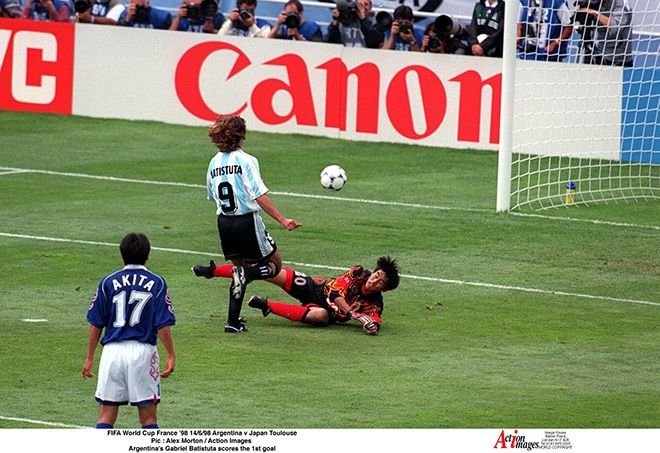
Japanese companies were once regular sponsors of the FIFA World Cup, with their logos and advertisements featured prominently at venues of the planet’s most-watched sporting event.
But their presence has faded.
Many of them are now peddling products and services that do not require such broad exposure, and a different corporate mindset seems to have taken hold.
Years and years of economic stagnation hammered home the point that international prestige does not necessarily translate into financial gain.
GLOBAL STAGE
The World Cup, of course, remains a huge stage for international companies to promote their brands.
“It has overwhelming popularity across a wide range of demographics, from developing countries to advanced economies,” said a former executive at a major Japanese electronics company. “Its advertising impact surpasses that of the Olympics and other sporting events.
“When we invited business partners to the World Cup event as part of sponsorship privileges, they were so delighted. I believe it had immeasurable positive effects on subsequent sales,” the former executive said.
Japan Victor Company, now JVC Kenwood Corp., was a sponsor of the World Cup from 1982 to 2002.
“We gained particularly high recognition in Europe,” a company official said.
During that period, Japanese consumer electronics were rapidly spreading worldwide, and JVC was focused on selling video and audio products, such as VHS players.
Fujifilm Holdings Corp. was also a World Cup sponsor from 1982 to 2006 through its predecessor, Fuji Photo Film Co.
A company representative said its sponsorship activities were intended to promote its photographic products.
Seiko Group Corp., which served as the official timekeeper for four consecutive tournaments starting in 1978, also focused on collaborations with prominent soccer players and advertising campaigns.
But in 2014, Sony became the last Japanese company to sponsor the World Cup. No Japanese company has done so in the last three tournaments.
Taking their place are companies from the Middle East, China and South Korea.
The list of sponsors for the 2026 tournament in North America includes: Aramco, Saudi Arabia’s national oil company; Qatar Airways; Chinese electronics makers, such as Lenovo and Hisense Group; and South Korea’s Hyundai Motor.
Structural changes at Japanese companies are a key reason behind their withdrawal as World Cup sponsors.
Japanese electronics giants that once regularly sponsored the event have reduced their reliance on consumer products, such as televisions, and shifted their focus toward corporate services like system development.
As a result, their need for broad public exposure has diminished.
For example, Toshiba Corp., which sponsored the 2002 and 2006 tournaments, sold its consumer electronics division to a Chinese company in the 2010s. Toshiba’s earnings now come mainly from power transmission and social infrastructure businesses.
The Regza television brand, originally Toshiba’s, is still involved in sponsorship activities at the current tournament, but the business is now operated by Hisense.
Sony, now Sony Group Corp., which was a top-tier “FIFA Partner” sponsor from 2007 to 2014, undertook structural reforms in the mid-2010s and scaled back its electronics business, including televisions.
The company also began studying whether certain promotional activities were directly tied to its business and brand.
So instead of simply using sports events for marketing, Sony has moved toward “investing in enhancing emotional experiences through technology,” said Kenji Tanaka, president of a Sony subsidiary responsible for sports-related businesses.
In 2024, Hawk-Eye Innovations Ltd., a Sony group company, established a joint venture with FIFA to develop technologies for real-time use of match data in officiating and analysis, including video assistant referee systems.
ECONOMIC DOLDRUMS
The weaker yen has also deterred Japanese companies from paying World Cup sponsorship fees, which are calculated in U.S. dollars.
Yoshihiro Oi, an associate professor at Waseda University who specializes in sports business, also noted the effects of Japan’s prolonged economic struggles since the bursting of the asset-inflated bubble economy in the early 1990s.
Since the 2000s, Japan’s economy has faced several challenges, such as the collapse of the IT bubble and the 2008 global financial crisis, that have prolonged stagnation.
Oi said that while it is possible for companies to estimate the financial effects of investing in sports events, it is impossible to measure them precisely.
He said companies previously invested in sporting events out of a sense of pride and prestige, not as a result of rational decision-making.
“More efficient, pragmatic approaches have taken hold, and companies no longer invest huge sums of money in projects with uncertain returns,” Oi said.
Oi said the location of the World Cup host will be a key factor on whether Japanese companies become World Cup sponsors again.
“If the tournament is held in regions expected to become major markets, such as India or Southeast Asia, some companies may consider participating,” he said.
(This article was written by Azusa Ushio and Makoto Tsuchiya.)
Original Source: This article was originally published on Asahi Sports. Click the link to view the full article.