

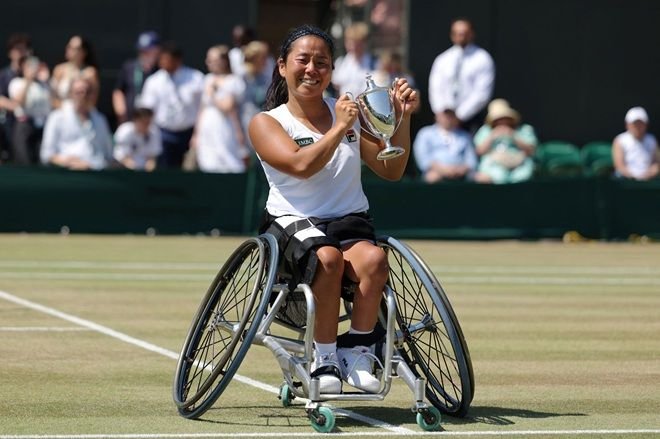
To fight fire with fire on tennis’ most prestigious stage and complete a Career Golden Slam, Japan’s Yui Kamiji had to change her baseline game into one predicated on power and attack.
To start, she embarked on the challenge by changing her racket.
Although she remained with the same manufacturer, Dunlop, she switched from a control-oriented model to one with greater power and rebound off the strings.
The change paid a massive dividend on July 11, as Kamiji steamrolled Diede de Groot of the Netherlands, 6-0, 6-0, to win her first Wimbledon’s women’s wheelchair singles title.
That also allowed the 32-year-old to complete a Career Golden Slam by capturing all four Grand Slam singles crowns and a Paralympic gold medal.
EMERGING FROM SLUMP
On the day Kamiji, who belongs to Sumitomo Mitsui Banking Corp., left for London before Wimbledon, she unusually opened up about her anxieties.
“To be honest, I feel like I’ve been going through a difficult period,” she said.
She had not been at her best since early spring. Day after day was filled with trial and error, as well as inner struggles.
Her mission was clear: to win the only Grand Slam singles title missing from her collection—Wimbledon.
Last year, she lost to rival Wang Ziying of China in the finals, 6–3, 6–3.
Wimbledon is the only Grand Slam played on grass courts.
Compared with hard courts, grass makes it more difficult for players to move and maneuver their wheelchairs.
Kamiji’s greatest strength is her consistency from the baseline, but on grass it is harder to draw opponents into the long rallies she relishes.
In last year’s final, Wang repeatedly struck aggressive shots early in the rallies, which overwhelmed Kamiji.
To counter that power, Kamiji concluded that the answer was to use the same tactics that had previously bedeviled her.
“I want to attack earlier. I want to pressure my opponents with a single shot,” she thought.
Once she identified the direction she needed to take, she felt her new racket could help her get there.
REASSURED BY A LEGEND
However, adjusting to a new racket was not easy.
Her old racket was more flexible and easier to control. With the new one, the ball really exploded off the strings when she took the ball early.
But because she had spent so long playing with her former racket, adjusting to the different timing required by the new racket was a challenge.
She even considered at times returning to her previous racket.
The person who encouraged her to stick with her equipment change was Japanese wheelchair tennis great Shingo Kunieda.
Kunieda, who served as both a practice partner and an adviser, told her, “The new racket puts more pressure on opponents during rallies. It has greater power.”
A five-time Wimbledon champion across singles and doubles, Kunieda knows the demands of grass court tennis.
“On grass, in a sense, the player who pulls the trigger wins,” Kunieda explained. “Rather than patiently contesting points through long rallies, if you can hit a powerful shot to the right spot, your opponent simply won’t get there.”
“When it comes to winning the Wimbledon title, I felt the new racket would give her a better chance.”
After their discussions, Kamiji made up her mind.
“I won’t be taking the red racket I used before to Wimbledon. I’ll go all in with the new blue one.”
With those words, she departed Japan.
TOUGH MATCHES TO THE TITLE
Her Wimbledon matches were anything but easy.
In the semifinals, Wang, the player who had beaten her in last year’s final, took the opening set.
Yet, Kamiji continued to attack boldly, recording eight service aces.
After more than two hours of intense competition, she prevailed in a final-set tiebreaker.
The championship match then presented the perfect rival for the final hurdle on her path to history: de Groot.
Since 2018, de Groot held the year-end world No. 1 ranking for seven consecutive years, earning a reputation as the sport’s “undisputed queen.”
During that period, Kamiji was consistently ranked second.
However, at the Paris 2024 Paralympic final, Kamiji defeated de Groot to claim the long-awaited gold medal.
Afterward, the Dutch player underwent hip surgery and spent an extended period away from competition.
She had only recently returned, winning the French Open, the most recent Grand Slam event before Wimbledon.
It was a showdown between the tournament’s top two seeds, with the higher-ranked Kamiji facing the second seed de Groot.
This time, Kamiji dominated.
Facing a six-time Wimbledon champion who was struggling with her serve, Kamiji stormed to the lopsided 6–0, 6–0 double bagel.
The match lasted less than 50 minutes—an unexpectedly one-sided result.
A key factor was Kamiji’s greater shot-making ability: she struck 20 winners, 13 more than her opponent.
Kamiji became only the second player in women’s wheelchair singles history to complete a Career Golden Slam, following de Groot.
During the on-court trophy ceremony, tears welled up in the Japanese superstar’s eyes as she reflected on her arduous journey.
“This week, it was really difficult to keep mentality and there were many ups and downs,” Kamiji said. “But there were always so many people behind me and so many supporters around me. I’m really, really happy to share this moment together.”
It is rare to see Kamiji become emotional during a victory speech.
The challenge of adapting to a new racket and the anxiety she carried into the sport’s most revered stage of Wimbledon made the victory more meaningful.
Having overcome those struggles, her joy was greater than ever.
Original Source: This article was originally published on Asahi Sports. Click the link to view the full article.