

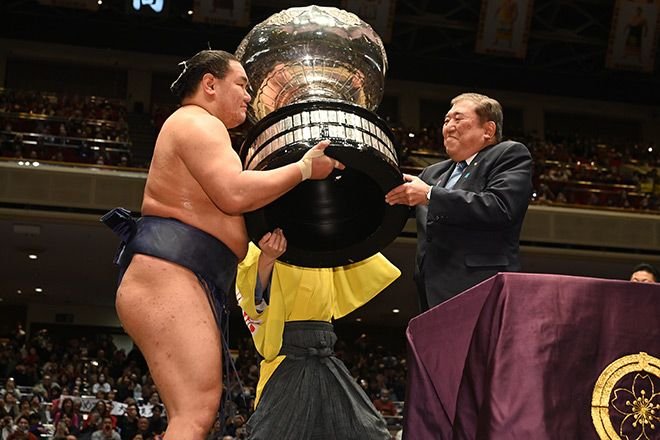
When Sanae Takaichi became Japan’s first female prime minister last year, questions were raised on whether she would step onto the dohyo sumo ring.
Citing tradition, the Japan Sumo Association (JSA) has refused to let female politicians enter the ring, even when a Prime Minister’s Cup is awarded to the makuuchi division champion at every sumo tournament.
Masataka Suzuki, a Keio University professor emeritus of cultural anthropology, said although many sacred places around the world are off-limits to women, Japan’s “permanent” ban concept related to “uncleanness” is rare.
In an interview with The Asahi Shimbun, Suzuki also noted that the controversy surrounding the men-only tradition in sumo became an issue only about 50 years ago, and that that taboos have always changed in line with the times.
Excerpts of the interview follow:
* * *
Question: Are such prohibitions against women unique to Japan?
Suzuki: Such taboo ideas are found not only in Japan but also around the world.
Sabarimala, a Hindu temple in the southern Indian state of Kerala, has been restricting entry of women after they start menstruation and before they experience menopause.
The Indian Supreme Court ruled the tradition unconstitutional in 2018, but the temple has refused to comply, and the protest movement is ongoing.
Mount Athos, a famous World Heritage site in Greece, is also known for a monastery that is strictly off-limits to women. It has been criticized in recent years, with the European Parliament adopting a resolution requesting the lifting of the ban.
Many sacred places, temples and festivals around the world are associated with taboos. But many of these taboos that are applied to women are temporarily limited to certain periods, such as menstruation and pregnancy.
I think that Japan’s “permanent” concept of “uncleanness” is rare in the world.
It is believed that Blood Bowl Sutra, a short sutra introduced to Japan from China in or around the 15th century, played a major role.
Also in secular places, British pubs and golf clubs caused a stir as they refused to let women enter. They did not expect women to enter such places that are seen as training grounds for gentlemen in male-dominated society.
Even the Vienna Philharmonic had viewed the classical music world as a male-centered field, but it started accepting female members in 1997.
CHANGES MADE FOR FOREIGNERS
Q: Have Japan’s ‘prohibitions against women’ also been changing?
A: They haven’t remained unchanged.
Until the Edo Period (1603-1867), places were off-limits to women in boundaries between sacred and secular realms on most mountains in Japan, where female worshippers were prohibited from paying respects.
But in 1872, the Meiji government announced the lifting of the ban on women, allowing them to enter mountains.
It was because of an expo held in Kyoto.
The government feared that if it were to refuse overseas visitors from climbing Mount Hieizan due to the ban on women, Japan could be viewed as being riddled with barbaric superstitions and culturally behind.
It might have been Japan’s first countermeasure to deal with inbound visitors.
Taboos have changed with the times. Tradition can be changed in a subtle manner.
Q: Is prohibiting women from entering the dohyo at the Grand Sumo Tournament a tradition?
A: The origin of the modern-day Grand Sumo Tournament was “kanjin zumo” of the mid-Edo Period. It was an entertainment event held to raise donations to renovate temples and shrines and build new ones.
Because only men practiced sumo, there was no idea of barring women from the dohyo.
The awards ceremony of the Grand Sumo Tournament was introduced based on American sports in 1909, when a permanent venue that later became (Tokyo’s Ryogoku) Kokugikan arena was built.
Furthermore, the Prime Minister’s Cup was created in 1968, paving the way for non-sumo personnel to step onto the dohyo and present the awards.
Q: When did banning women from the dohyo spark controversy?
A: That was after a “wanpaku zumo” (children’s sumo tournament) held in 1978.
The JSA denied a girl who made it through the qualifying round from going to the Kuramae Kokugikan for the final match.
Mayumi Moriyama, then head of the Women’s and Minors’ Bureau at the Labor Ministry, felt pity and summoned a JSA director to ask him why women were prohibited from entering the dohyo and whether it was because they were considered “impure.”
The director answered that it was because only men were allowed to compete at the Grand Sumo Tournament, that the dohyo was a sacred place, and that he wanted to protect the tradition.
It was the first time the word “tradition” was used to explain the situation. It was the beginning of everything.
Moriyama later became the first female chief Cabinet secretary in 1989, and wanted to hand over the Prime Minister’s Cup at the New Year Grand Sumo Tournament in 1990 on behalf of the prime minister.
The JSA shot down her request, again citing “tradition.”
The topic of “women being barred from the dohyo” instantly spread through the mass media.
In 2018, when the male mayor of Maizuru (in Kyoto Prefecture) collapsed while giving a speech in the dohyo during a regional tour in the city, women were told through the PA system to stay out of the ring–even though they were providing emergency care. The incident went viral on social media, triggering a flood of criticism.
The JSA issued a statement of apology in the name of the chairman, saying it was an inappropriate response.
CHANGING TRADITION
Q: How do you think debates over the “men-only” tradition should be?
A: According to reports, it seems the JSA’s inquiry commission on women and the dohyo has yet to reach a conclusion or compile guidelines.
Tradition is not necessarily something that remains unchanged. Rather, it is something that has been practiced for generations as it gradually changes itself to correspond to the flow of the times.
It must be revised all the time.
* * *
Born in 1949 in Tokyo, Masataka Suzuki has conducted field studies in Sri Lanka, South India, China, Japan and elsewhere.
His books on Japanese culture include “Nyonin Kinsei no Jinruigaku” (Anthropology in prohibitions against women) and “Sangaku Shinko” (Mountain worship).
He also served as head of the Association for the Study of Japanese Mountain Religion.
Original Source: This article was originally published on Asahi Sports. Click the link to view the full article.