

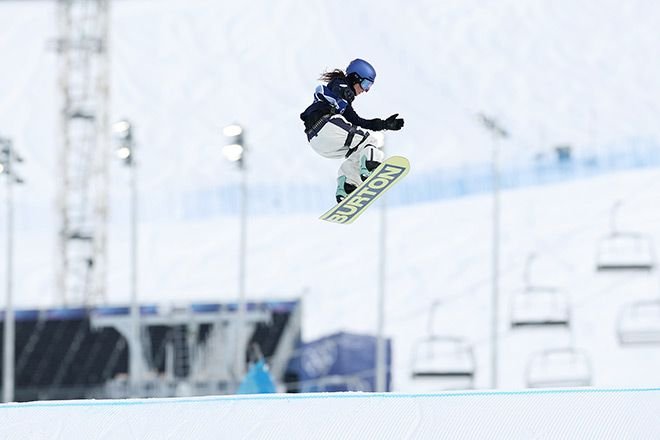
Japanese competitor Mari Fukada blended in with the public at a nearby ski resort for extra practice riding the rails before competing in the 2026 Milano Cortina Winter Games.
Fukada, 19, won’t be a stranger any longer after making history on Feb. 18, winning the Women’s Snowboard Slopestyle final to become the youngest Japanese woman ever to claim Winter Olympics gold.
Her victory also marked the first time a Japanese woman has medaled in the event.
“I can’t believe it. My mind went completely blank,” the rising star said through tears and laughter, moments after clinching the top spot in her Olympic debut. “I was able to execute every last detail perfectly.”
Fukada, who placed seventh in the qualifiers, stumbled on her first run in the final.
After falling, she executed her second attempt with precision, scoring 85.70 points to leap from ninth place into the lead.
Freed from pressure, she went on the offensive in her final run, landing every trick flawlessly to improve her score to 87.83 points and seal her place at the top of the podium.
As she landed her final jump after soaring in a grand arc, Fukada threw both hands into the air in triumph.
VICTORY IN THE DETAILS
While slopestyle is known for its spectacular aerials, the competition was decided on the technical, rail-like obstacles known as “jibs” at the start of the course.
Fukada mastered the three consecutive rails.
In her third and final run of the final, Fukada executed the jib section flawlessly, scoring 24.50 points overall for her three runs. This was the third-highest score overall, following her first and second runs.
While her scores on the three jumps in the latter half of the course were lower than that of silver medalist Zoi Sadowski Synnott of New Zealand and bronze medalist and fellow Japanese rider Kokomo Murase, Fukada’s technical mastery of the rail section gave her the winning edge.
THE PERFECTIONIST’S PATH
Fukada, who hit the slopes at age 3 and started snowboarding in the first grade, is a “perfectionist” acknowledged by both herself and others.
Behind her victory lay meticulous preparation.
Because the length and thickness of the rails differ at each competition, she spent her pre-Olympic training camp in China practicing on various types.
During the Games, since official practice sessions weren’t enough, Fukada sharpened her skills at the local ski resort.
She was relentless in perfecting her body orientation, posture, board angle and landing precision until she was completely satisfied.
A FATEFUL ENCOUNTER
A chance encounter with coach Yasuhiro Sato six years ago proved pivotal.
Fukada, then 13, received a brief 30-minute lesson from Sato—who was coaching world-class rider Takeru Otsuka at the time—and felt an immediate improvement.
She soon began commuting every weekend to Sato’s training facility in Saitama Prefecture.
“Technically, she had a lot of power,” Sato recalled. “She could flex the board to get more air. As a snowboarder, she is also incredibly stylish.”
Above all, Fukada possessed a resilient body and a competitive spirit that hated to lose. She would complete nearly five times the usual number of jumps in an hour and kept training long after others quit in bad weather.
REDEMPTION AFTER HEARTBREAK
Her growth was remarkable, culminating in a World Cup victory at age 15.
Sato became convinced then that she could win gold in Milano Cortina.
But her Olympic journey began with a setback.
On Feb. 9, in the Big Air event—considered her specialty—Fukada finished a disappointing ninth while her teammate Murase claimed gold.
In the shadow of the jubilant medal ceremony, Fukada shed bitter tears alone.
“I want to get my revenge in the slopestyle,” she vowed.
Nine days later, she delivered on that promise, turning deep frustration into a historic gold medal.
“I was so frustrated that I cried a lot,” she said. “But I’m so glad I never gave up.”
Original Source: This article was originally published on Asahi Sports. Click the link to view the full article.