

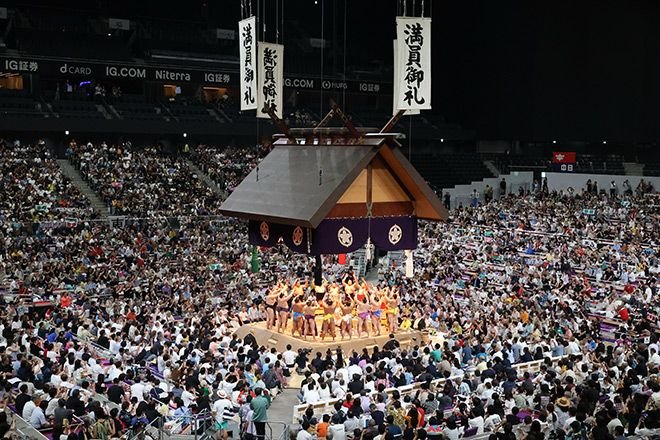
Happy days are here again for Japan’s traditional sport, with overseas fans packing sumo arenas, turning the centuries-old ritual into a must-see global spectacle.
Riding this wave of popularity, the sport will break a 20-year hiatus with an international tour this fall—a clear signal that the Japan Sumo Association is intent on harnessing its growing appeal beyond Japanese shores.
Professional sumo will step onto the world stage this fall with its first overseas tour in 20 years, with five days of the sport’s top wrestlers competing in London.
The move reflects foreign fans flocking to Japan’s arenas to witness sumo’s titanic clashes—and a governing body increasingly mindful of its international audience.
BOOM AT HOME BUT CRACKS APPEAR
At home, the ancient spectacle where ritual collides with raw power is enjoying a golden resurgence. In 2024, every seat for all six “honbasho”—15-day tournaments held across 90 days each year—was sold out.
It was the first full-season sellout since 1996, when the “Waka-Taka boom” ignited nationwide fervor around the powerhouse brothers Wakanohana and Takanohana, both of whom reached the exalted rank of yokozuna.
The streak has carried into 2025: from January in Tokyo to July in Nagoya, the first four tournaments sold out. Tickets have morphed into near-mythical “platinum passes,” fiercely coveted and almost impossible to obtain.
A key force behind the boom is the upswing in inbound tourism. Using the distribution of English-language bout schedules as a yardstick, the JSA estimates that roughly 30,000 foreigners attended the May tournament at Tokyo’s Ryogoku Kokugikan, the sport’s 11,000-seat main arena.
That averages about 2,000 overseas visitors per day—nearly 10,000 more than before the COVID-19 pandemic and close to one-fifth of the total attendance.
Travel companies are racing to meet the demand. JTB Corp., which sells package tours that bundle sumo tickets for foreign visitors, reported record sales last year and says bookings are climbing even faster this year.
“We can feel sumo’s rising popularity abroad firsthand,” said a JTB official.
The JSA, too, has begun to court global fans. In August 2022, it launched Sumo Prime Time, an English-language YouTube channel showcasing the sport’s history, culture, and finer points. The channel now boasts around 87,000 subscribers across 170 countries.
“We want as many people as possible to watch—and to come,” a JSA official said.
But even as the sport thrives, challenges persist at home. Chief among them is a steep decline in new Japanese recruits. Foreign wrestlers, by comparison, continue to fill the ranks.
From the Hawaiian trailblazers of the period from the 1980s to the 2000s to the Mongolian champions who reshaped the sport in subsequent years, overseas rikishi have carved out lasting legacies.
Today, nearly a quarter of the top-division makuuchi wrestlers hail from abroad, including several from Europe.
That success has fueled unease about foreign dominance. A long-standing gentlemen’s agreement restricts each stable to just one non-Japanese recruit. Some insiders now argue that loosening the rule could help offset the dwindling supply of homegrown talent.
But such a step would pose challenges for the sumo community, where integrating young wrestlers from different cultural backgrounds into a tightly tradition-bound world is never simple.
Konishiki Yasokichi, the American-born former ozeki from Hawaii and the first foreigner to reach sumo’s second-highest rank, believes the answer lies in clarity.
“They need to think about how to bring foreigners in. What matters is to set proper rules and make sure overseas recruits understand them completely,” Yasokichi said.
Experts caution that internationalization comes with new responsibilities.
Kosuke Takata, an assistant professor of sports tourism at Waseda University’s Faculty of Sport Sciences, emphasizes the need for careful international communication.
Traditions that may baffle outsiders—such as the ban on women entering the dohyo—should be presented with their cultural background intact, he argues, so that the sport is understood rather than misconstrued.
Takata also raises the issue of governance.
“The association’s instinct to manage everything on its own makes sense from the standpoint of cultural continuity. But ensuring that sumo is conveyed overseas without distortion may require more than the association alone can provide,” he said.
As sumo reaches outward, he added, it must also guard against drifting out of sync with the Japanese public, who regard the sport as part of their shared cultural heritage.
LONDON CALLING AS SUMO HEADS ABROAD
This October, sumo will once again step onto the global stage. For the first time since Las Vegas in 2005, the Japan Sumo Association will take its wrestlers overseas, staging a five-day exhibition at London’s storied Royal Albert Hall.
JSA Chairman Hakkaku (the former yokozuna Hokutoumi) announced the plan at the venue last December, pledging, “We will do everything possible to ensure that fans can fully enjoy the appeal of sumo, one of Japan’s ancient cultural traditions.”
For Hakkaku, London carries a personal resonance. As an active yokozuna, he competed there in the 1991 exhibition.
“The atmosphere was electric. I remember being called the ‘Bulldog, my nickname,’” he recalled with a smile.
Overseas tours have long doubled as cultural diplomacy, designed to showcase sumo while deepening ties between Japan and host nations. These official exhibitions are typically held at the invitation of foreign partners.
Distinct from them are commercial overseas barnstorming tours organized by outside groups that purchase the rights from the JSA—the last of which was staged in Jakarta in 2013.
The first overseas sumo exhibition was held in 1965 in Moscow and Khabarovsk. It came about after Japan and the Soviet Union restored diplomatic ties in 1956, when Soviet officials invited the JSA to take the sport abroad.
Senior Soviet officials dubbed the wrestlers “naked ambassadors”—a nickname that stuck.
The second tour followed in 1973, marking the normalization of Japan–China relations, with stops in Beijing and Shanghai. From there the circuit expanded: Mexico in 1981, New York in 1985, Paris in 1986, and a string of five tours through the 1990s.
Another Paris exhibition is already on the calendar for June next year.
But such ventures have not been without hurdles. The clay used to build the dohyo in official tournaments is called “Arakida-tsuchi”—a sticky, highly cohesive soil found in rice paddies and river deposits, sourced from Kawagoe in Saitama Prefecture.
Because it is subject to strict quarantine controls, shipping the soil overseas is virtually impossible. Organizers must instead procure the proper clay locally, adapting it to meet the exacting standards of the sport.
Katsuharu Ito, 82, who served as the 34th Kimura Shonosuke—the highest-ranking gyoji (referee) in professional sumo—who joined many overseas tours, recalled how officials would carefully test different types of soil before settling on one.
“Sometimes the clay was much darker in color. If the ring was too soft, wrestlers risked injury, so the stablemasters paid close attention to the quality of the dohyo clay,” he explained.
For the wrestlers, these journeys were more than simple exhibitions; they became moments of reflection and self-discovery.
In a 1993 interview for the JSA’s public relations magazine, then-Chairman Dewanoumi (the former yokozuna Sadanoyama) spoke about the deeper meaning of taking sumo abroad.
“When Japanese culture and tradition are admired overseas and people’s attention turns to sumo, it inspires the wrestlers themselves to take pride in their heritage,” he said.
Original Source: This article was originally published on Asahi Sports. Click the link to view the full article.