

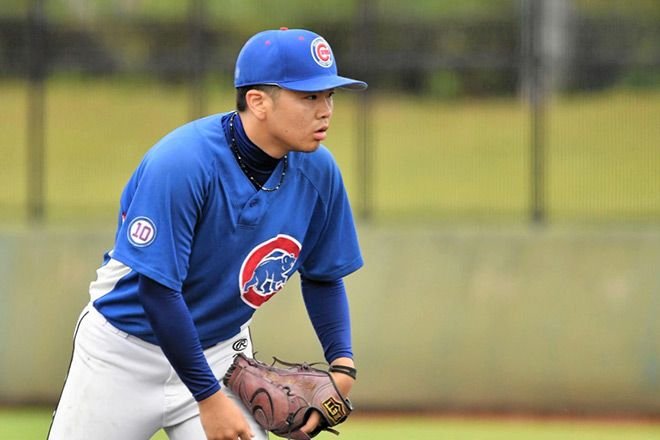
Relief pitcher Shuto Okumura achieved one dream of playing top-level college baseball in the United States, as he nears the end of his final season at Illinois State University.
Next up in the right-hander’s list is taking the mound in the major leagues.
Okumura, 22, graduated from Tenri High School in Nara Prefecture, a national high school baseball powerhouse.
But unlike some of his teammates who have already gone onto pro careers, Okumura started his long quest from the bottom.
The late bloomer had difficulties making the roster at his alma mater, which has won the national high school baseball championship at Koshien Stadium three times in both the spring and summer tournaments.
FAILED TO SHINE AT A TOP SCHOOL
Okumura has always pitched since he was an elementary school student.
His classmates at Tenri included Kota Tatsu, who later began his professional career after he was selected in the first round by the Hokkaido Nippon-Ham Fighters, and Seiya Akagi, who was the No. 5 draft choice of the Hiroshima Carp.
Surrounded by many pro prospects, Okumura felt he was behind in his skill level soon after he entered high school.
“In my grade, I was the fourth or fifth pitcher on the roster. Tatsu and others who had been playing active roles since their younger years were from another world,” he recalled.
After he switched his pitching delivery from overhand to sidearm, Okumura was given uniform number 20 for the fall season when he was a second-year student.
But as a third-year student in spring the following year, he couldn’t make the roster as the team advanced to the semifinals at the High School Baseball Invitational Tournament for the first time since 1997, when the squad won the tourney.
“I was motivated by the frustration I had at the time to aim for a higher level,” he said.
Okumura, whose fastball registers between 130 and 139 kph, searched for his own competitive edge as a breaking ball pitcher while he compared himself to Tatsu, who can hit speeds near 150 kph on the radar gun.
Although he strived to improve the quality and control of his breaking balls and repeatedly took the mound, the team lost in a semifinal at the summer Nara prefectural tournament, his final season.
HEADING OVERSEAS TO PLAY IN U.S.
When Okumura was thinking about his plans after graduation, it was his own background that helped broaden his options.
He was born in the U.S. state of Michigan and raised in Takatsuki, Osaka Prefecture.
Encouraged by Ryoji Nakamura, the then coach at Tenri who currently leads Osaka Gakuin University’s baseball team, Okumura participated in a tryout held in the autumn, which was observed by representatives from U.S. colleges.
It opened the door for him to study in the United States.
He received a glove in the team color of purple as a farewell gift from Nakamura.
Once in the United States, Okumura gained experience playing for a junior college for two years.
He won the confidence from his teammates as a relief pitcher, studying hitters’ tendencies and throwing different kinds of breaking balls to shut them down.
He then received a scholarship two years ago and transferred to Mississippi Valley State University to fulfill his long-held dream of playing at an NCAA Division 1 school, the highest level of U.S. collegiate athletics.
In August 2025, Okumura struck a better deal and transferred to Illinois State University, which is also a Division 1 school.
While living in the United States, Okumura strongly felt the need to ask questions to improve his skills.
Coaches of top-tier teams usually do not instruct their players step by step, so the best way to learn is to ask questions.
To do so, one must grasp their own strengths and weaknesses and put their thinking into words.
As he started thinking in concrete terms what he needed to work on, Okumura’s quality of his training improved.
INSPIRED BY OLD FRIEND
Okumura continues to be inspired greatly by Tatsu from “another world.”
In 2024, the two former teammates joined individual training sessions in the U.S. state of Arizona during Tatsu’s off-season.
Okumura was amazed to see how the Nippon-Ham Fighter pitcher connects everything–from how he trains himself to what he eats–to baseball.
“When Tatsu gets things done at this level this far, I have to do even more because I am an amateur,” Okumura said.
He also received assistance from Tatsu and Akagi.
During a game in February 2023, Okumura lost his form after a defensive mix-up and left the mound.
He suddenly collapsed in the bench area. When he awoke, he found himself lying on a hospital bed with no memories of his past.
He couldn’t remember his parents, let alone his high school days. He was diagnosed with stress-induced transient amnesia.
The purple glove his old mentor gave him was placed on the side of the bed, and it helped him remember that he was a baseball player.
After learning of their friend’s predicament, Tatsu and Akagi frequently contacted Okumura and talked about their high school experiences.
Fortunately, Okumura regained some of his memories in the latter half of the following month and returned to playing baseball.
To show gratitude to those who supported him, he has been donating several dollars to a medical institution every time he gets an out in a game since 2024.
He uses his baseball gear with care and employs other cost-saving measures to provide funds from the scholarship for his cause.
For his final collegiate season, which ends in February, Okumura said he wants to string as many zeros as possible across the scoreboard.
He is determined to play in the major leagues, even if it means he has to play in the independent baseball league first to prove himself.
“I want to keep trying and become someone who increases the value of Japanese players,” he added.
Original Source: This article was originally published on Asahi Sports. Click the link to view the full article.