

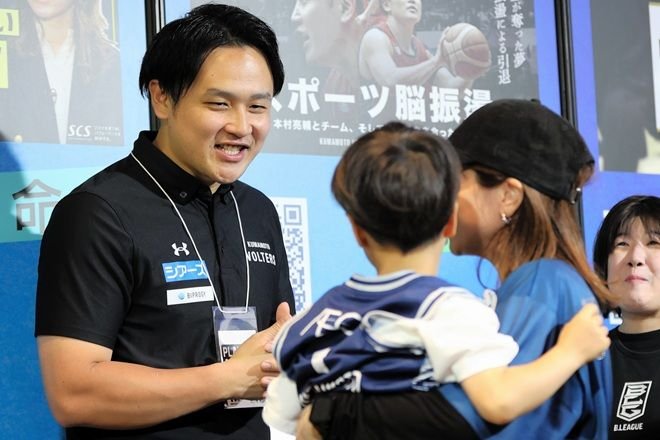
He slammed into opponents on the court, falling and rising again. But repeated blows led to headaches, dizziness and aversion to bright lights, and Ryosuke Motomura found that he couldn’t continue.
The shooting guard for the Kumamoto Volters, in the B2 division of the Japan Professional Basketball League, didn’t want to be benched or be a nuisance. For a long time, he pushed on without complaint.
“I should have taken better care of my body,” said Motomura, 29. “I was naive about concussions.”
Eventually he faced up to his problems and retired in May 2025.
CUMULATIVE DAMAGE
Motomura sustained his first major concussion during a game in 2023.
He collided with an opposing player while fighting for a rebound and fell, slamming the back of his head on the floor.
Over the weeks ahead, the blows continued. Motomura developed symptoms that pointed to a concussion.
What began to scare him was that the symptoms were not immediate. Sometimes, dizziness would come on days later. Sometimes, it was a week.
The damage was getting worse. His symptoms were getting more severe, and he reached the point where even a soft blow might set them off.
It wasn’t just the headaches. He became sensitive to light and noise, and developed intense mood swings.
Mentally, Motomura was being pushed to the limit.
“I sometimes forced myself into playing because I was in a rush to be back in playing shape,” he said.
Eventually, his symptoms started affecting not only his playing performance but also his daily life. Exposure to sunlight would give him a headache so strong that it made him feel he would pass out.
When he went outdoors, he would wear a hoodie to cover his head. When the symptoms were bad, he would stay in his bedroom.
His teammates offered support. They gave him compassion, and it was genuine.
But Haruo Nakayama, a neurosurgeon and associate professor specializing in head injury at Toho University Medical Center Ohashi Hospital, told Motomura his personal life would suffer if he were to continue with his career.
Motomura was worried about the effects on his life and his loving family, and he decided to retire.
One year on, his symptoms linger. He still occasionally feels discomfort when under bright lights.
NEW CAREER
Motomura was appointed as player development coach and youth adviser for the Kumamoto Volters in the 2025-2026 season.
As a coach, he encourages players to come forward with their symptoms. His priority is to make an environment in which they feel they can.
Concussions are difficult to discuss because the symptoms are often invisible to others. It’s the sufferer who alone feels them.
And it’s a problem if a player doesn’t speak up.
“When they say they don’t have any symptoms, there is nothing others can do about it,” Motomura said.
The B.League has introduced a concussion protocol to help players return to court. Motomura and his team followed it, to enable his partial comeback.
Motomura thinks it is crucial to prepare an environment where teammates, coaches, young players and their guardians can work with one another.
He goes to great lengths to ensure they understand concussions are not something that go away after a short rest.
“We all must be aware of concussions,” he said. “It is important to build a relationship of trust where players can come forward with their symptoms.”
EXTENDED RECOVERY
Concussion-related abnormalities cannot usually be detected by CT or MRI scans, Nakayama said.
He cautions that measures to reduce concussions are not treatment. They simply help to reduce the long-term damage.
And it is long term. Most players who recover find that their athletic performance is diminished.
Even though they are back in the game, they and their supporters need to know that it will take time to return to their previous level.
(This article was written by Masashi Shimizu and Ryusaburo Matsumoto.)
Original Source: This article was originally published on Asahi Sports. Click the link to view the full article.