

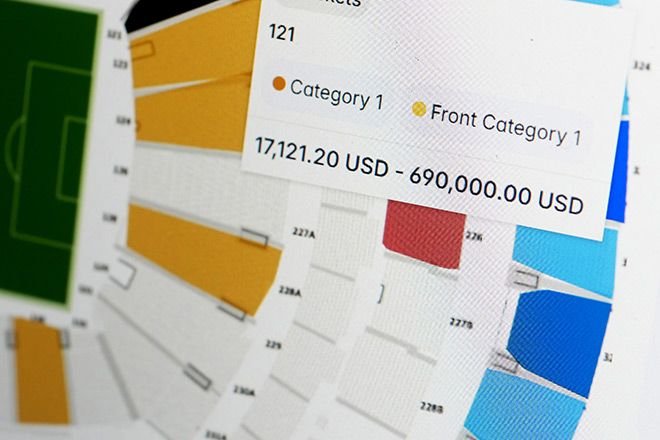
Ticket prices for the 2026 FIFA World Cup have surged to staggering levels.
Even if it’s a priceless experience, isn’t the price a little too high?
I imagine many Japanese fans on-site likely lamented the price tags.
The official resale price for the Japan-Brazil knockout-round match, posted on FIFA’s site, exceeded 300,000 yen–even for the cheapest seats–immediately after the match was announced.
I resent the weak yen.
The surge is driven by FIFA’s “dynamic pricing” system introduced for the tournament, which adjusts prices in real time based on supply and demand.
This is a method familiar for airline tickets and hotel bookings. An algorithm predicts demand, and prices are cheap in the off-season but leap during busy periods.
By the knockout stage of the World Cup, price decreases are unlikely.
In the past, FIFA did not indulge in “excessive profits” from tickets. It was difficult to do so.
A useful contrast is the World Cup hosted by the United States 32 years ago.
In 1994, the year of the “pre-internet era” before Windows 95 was released, World Cup tickets were printed on paper.
According to a report in an American newspaper at the time, even the final’s expensive seats were $475. Converted at the era’s dollar–yen rate, that was just under 50,000 yen.
Back then, scalpers roaming around the stadiums largely dictated price swings based on supply and demand.
But would I prefer life before the internet? I’m hard pressed to answer.
Nowadays, when you fly, you don’t have to go to the counter to check in. When you travel domestically or internationally, services like Google Maps tell you the routes to hotels and tourist spots and even bus timetables.
I cannot resist the convenience of technological innovation.
Jointly hosted in the United States—the cradle of large tech companies that have made the world more convenient–the soccer tournament has seen FIFA leverage IT to increase U.S. ticket revenue.
In the United States, where pro sports enjoy strong following and a mature resale market, FIFA has chosen to profit by acting as an intermediary rather than banning resales.
Under this system, FIFA collects 15 percent from both sellers and buyers. It also allows sellers to freely set their desired resale price.
It reflects a neoliberal idea that relies on “free” market dynamics.
In other words, the higher the ticket prices, the more fees FIFA pockets. It’s easy money for FIFA.
If World Cup viewing becomes a luxury enjoyed by the wealthy and the stadium’s fervor fades, FIFA could face trouble.
However, when I watch World Cup broadcasts from Japan, I see cheering squads of fans turning up for every team.
But I worry that fans of countries with a lower GDP per capita may be straining their household budgets by traveling to North and Central America.
I wonder if many of these supporters are immigrants living in the United States.
If I had covered the World Cup on-site, I would have asked these spectators where they came from, how large their travel budget was, and what their annual income was.
On the other hand, the contrast with those who cannot enter the venues is stark to me. It feels like a microcosm of modern society where economic inequality widens.
If broadcast rights fees rise, I think some people will be unable to enjoy the World Cup even on television.
FIFA, headquartered in Zurich, enjoys Swiss tax advantages as a nonprofit under Swiss law. Its four-year total revenue is projected at about $13 billion (roughly 2.1 trillion yen).
I urge FIFA to avoid succumbing to greed and to exercise the awareness and restraint required to oversee a festival that can truly be described as a “global public good.”
FIFA has a chartered goal. It states that the organization aims “to promote (the game of football) globally in the light of its unifying, educational, cultural and humanitarian values.”
I think there is a gulf between FIFA’s lofty ideals and reality.
Original Source: This article was originally published on Asahi Sports. Click the link to view the full article.