

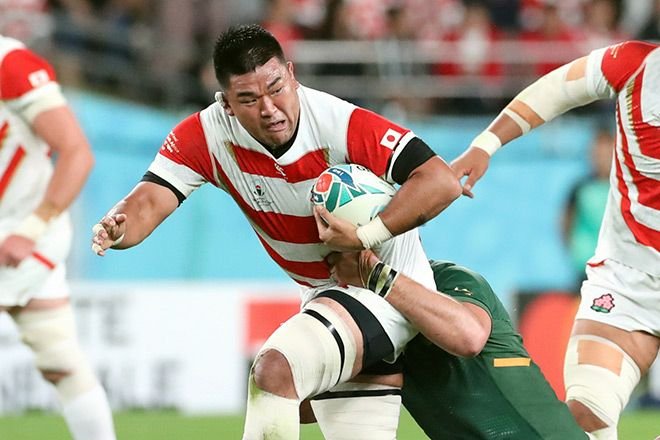
Twenty-seven rugby players who were born overseas and later acquired Japanese nationality are challenging the top Japanese rugby league’s new registration rules, saying that they will reduce playing opportunities and impact their contracts.
The players filed a complaint with the Japan Fair Trade Commission on April 20, arguing that a new player registration system set to take effect next season in League One violates the Anti-Monopoly Law.
Some of the 27 players have also filed petitions with the Tokyo District Court seeking a provisional injunction.
Among the 27 litigants, Jiwon Gu, Isileli Nakajima and Timothy Lafaele, all from the Kobelco Kobe Steelers, AsaeliAi Valu of the Saitama Panasonic Wild Knights, Hendrick Tui of the Urayasu D-Rocks and Lemeki Lomano Lava of the Mie Honda Heat agreed to have their names made public.
All six played for the Brave Blossoms, the Japanese men’s national rugby team, when it achieved a historic first by reaching the final eight at the 2019 Rugby World Cup.
What will change in League One starting next season is the classification of registered players.
Speaking to reporters, the players’ attorney said, “We want to urge the league to reconsider.”
Under the current system, players who are eligible to represent Japan are mainly classified as “Category A.”
Beginning next season, however, the category will be subdivided, with the creation of a new “A1” category for players who spent at least six years in Japan during the period of compulsory education.
Meanwhile, players who moved to Japan from high school onward will be placed in a separate “A2” category, which will highly likely result in fewer playing opportunities.
However, players who have played in 30 matches or more for the Japanese national team will be treated as A1 players under a special exemption.
Seiji Makino, an attorney specializing in legal matters in sports, argues that the new system constitutes an abuse of superior bargaining position or discriminatory treatment prohibited under the Anti-Monopoly Law.
“Whether the rule itself is justified and whether it infringes on rights that players have been granted up to now are two separate issues,” he said. “It is difficult to see how the condition of having spent six or more years in Japan during compulsory education is an appropriate reason for depriving players of those rights.”
Original Source: This article was originally published on Asahi Sports. Click the link to view the full article.