

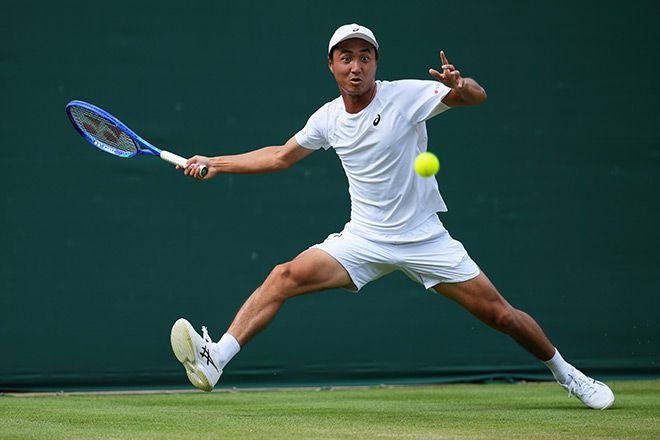
When Shintaro Mochizuki fell to the grass in celebration at Wimbledon on July 1, he was the latest example of a quiet takeover on the world’s top tennis courts.
Securing his first-ever spot in the third round of a Grand Slam, Mochizuki lay spread-eagled, the soles of his Asics shoes pointed to the sky.
The Japanese player favors the brand’s lightweight “speed-type” model, which he says is critical for his game.
At 175 centimeters tall, Mochizuki is relatively short in men’s professional tennis.
“I cover a lot of ground,” he said. “My reach is also short, so I have to take an extra step to get closer to the ball. I do train, but my shoes help me, too.”
His choice reflects a dominant trend. From the grass courts of Wimbledon to the clay surfaces of Roland Garros, Asics boasts the No. 1 market share in men’s singles footwear, a position built on meticulous research and player trust.
UNSPOKEN ENDORSEMENT
This dominance is no accident.
Since 2024, the Kobe-based company has surveyed the footwear of all 128 men’s singles players at every Grand Slam event, using on-site visual checks and video reviews.
The data shows that in nine of the last 10 majors, from the 2024 Australian Open through this year’s French Open, more athletes chose Asics over rivals Adidas, Nike and Yonex.
Crucially, this adoption extends beyond sponsored athletes. Twenty-seven players sported Asics during this June‛s French Open, 11 having no contract with the company.
Top Japanese player Kei Nishikori is another prominent example of a non-contracted player who chooses the brand.
“We are happy that even players without contracts are choosing our shoes, as it feels like our technological capabilities are being recognized,” said Masashi Seo, 46, who leads the “T-Project,” a special division reporting directly to the company’s president.
While Asics first released tennis shoes in 1952, its serious push into the market began in the 2010s, signing popular French player Gael Monfils to raise its visibility on tour.
By 2019, its share among the top 100 men’s players had climbed to second or third.
ENGINEERED TO OFFER EDGE
A key to its success is offering two distinct shoe models. Mochizuki‛s preferred speed-type aids smooth forward movement.
Meanwhile, Asics’ “stability-focused” model features a low center of gravity for solid footing, allowing players to choose based on style and preference.
This strategy was formalized two years ago when the T-Project was launched with the goal “to make tennis the next pillar of revenue after running.”
Its objective is clear: secure the No. 1 market share at the Grand Slams and in global sales.
Choosing tennis over other sports such as baseball or soccer was deliberate.
“Tennis is a high-intensity sport, so many people choose their shoes based on performance,” Seo explained, noting its broad, global consumer base of all ages presents a huge business opportunity.
Since then, the company has signed more top-10 players and prestigious academies and partnered with a French research institute.
It has also meticulously responded to player needs, such as redesigning shoes to prevent laces from snapping due to friction with the court during intense footwork.
The results are evident. As of 2024, Asics claimed the top sales market share in Europe and Australia, while sitting at No. 2 in Japan, the United States and China. It has since climbed to the top spot in the United States as well.
Original Source: This article was originally published on Asahi Sports. Click the link to view the full article.